
Romanians understand and live couple relationships pragmatically rather than romantically
Reveal Market Resources, study no. 207
The latest Reveal Marketing Research study explores how Romanians understand and live couple relationships and what are the most important elements in maintaining them.
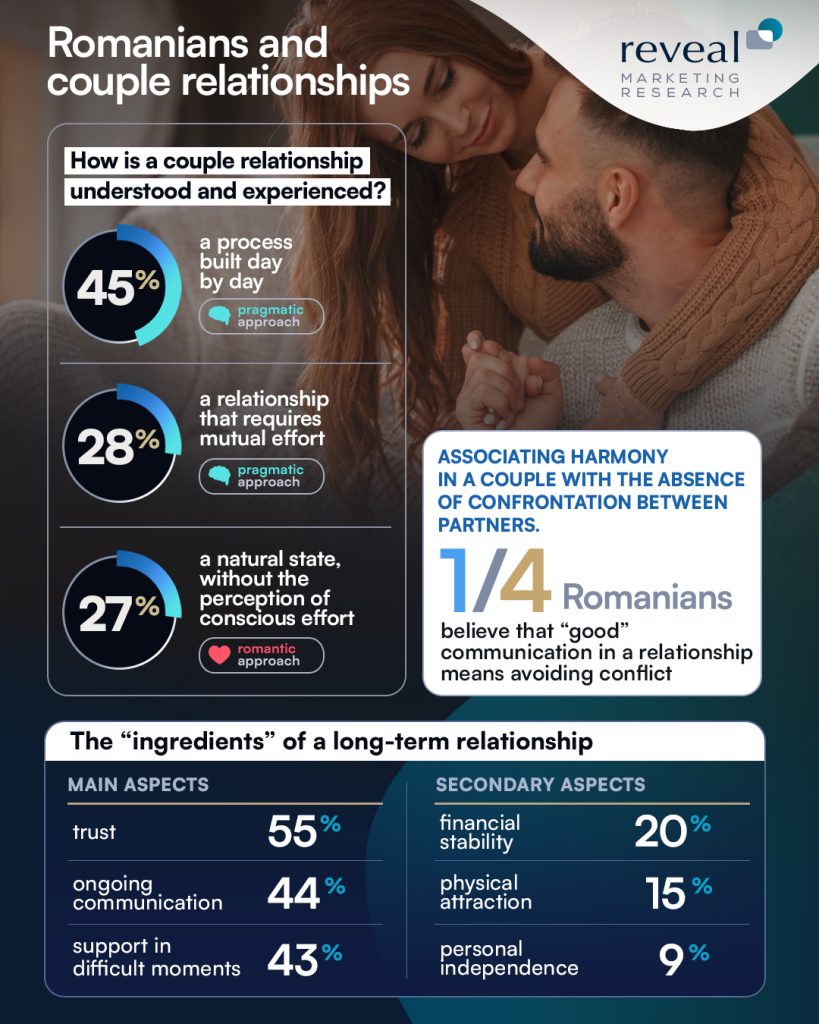
- The relationship is perceived rather as a process that is built daily (45%) and requires mutual effort (28%).
- The main “ingredients” that strengthen a long-term relationship are trust (55%), constant communication (44%) and support in difficult times (43%). Physical attraction (15%) and independence (9%) matter to a lesser extent.
- Avoiding conflict appears as part of communication in the relationship (24%), which reflects a tendency to associate harmony with the lack of confrontation.
- At the beginning of a potential relationship, Romanians say they emphasize common values (52%), safety transmitted by the other person (43%) and emotional intelligence (40%).
The love relationship, more of a process than a natural state
The dominant perception is that a love relationship is actively built. 45% of Romanians believe that a healthy relationship is built daily, and another 28% say that it involves work on both sides. Only 27% see love as natural and effortless. The generational gap highlights the change in perspective: 41% of those aged 25–34 believe in love that comes by itself, without feeling like they are making an effort, while 53% of those aged 35–44 are more supportive of the idea of daily construction.
The quality time spent as a couple is defined by proximity and common routine
57% of respondents associate quality time spent together with relaxing together at home, far beyond activities perceived as special or different. Walks or common hobbies count for 42%, trips for 27%, and romantic outings for 21%. The 18–24 year old segment gives significantly more importance to romantic outings (50%), while the more mature age segment 35–44 years old gives a significantly lower importance (15%), confirming the idea that spending time as a couple in special and romantic contexts is rather an expectation of younger ages.
Trust and communication are the central pillars of the couple relationship
As for the “ingredients” of a long-term relationship, trust is mentioned by 55% of Romanians, constant communication by 44%, and support in difficult times by 43%. These percentages are significantly higher compared to other factors such as financial stability, 20%, or physical attractiveness, 15%. Gender differences are relevant: constant communication matters more for women, 48% compared to 40% for men, while financial stability is more important for men, 24% compared to 16% for women.
Communication is both ideal and vulnerability
52% of Romanians indicate poor communication as the main cause of destabilization of relationships, especially women (55% compared to 48% in the case of men) and people between 35–44 years old (59%).
At the same time, when defining “good” communication in the relationship, 63% associate it with total sincerity and 28% with listening without judgment. Only 23% talk about resolving conflicts quickly, and 24% about avoiding them, which shows a tension between the desire for harmony and the real ability to manage conflict.
Jealousy is more specific to young relationships
Jealousy is the second major factor in destabilizing a relationship, mentioned by 46% of respondents, reaching 58% among 18–24 year olds, suggesting more emotionally intense relationships.
In contrast, financial problems are less invoked by the 25–34 age group, only 19% (compared to 26% of the total sample), which indicates a change in priorities with age and relational experience.
Declarative expectations at the beginning of a relationship are more mature than physical attraction
In the initial interest and evaluation phase of a potential relationship, common values are the main criterion for 52% of Romanians, followed by the safety transmitted by the other person (43%), emotional intelligence (40%) and sense of humor (37%). Physical appearance is relevant for 27% of respondents, but reaches 36% among men (compared to 18% for women) and 42% among young people aged 18–24.
Relationship security is an umbrella concept, with different meanings
The safety conveyed by the other person (43%) is the second most important criterion that can lead to a relationship.
Security in the couple is “translated” by Romanians through fidelity (44%), communication (40%) and emotional support (40%), while financial stability matters to a lesser extent (20%). Gender differences validate emotional interpretation: emotional support matters more for women, 43% vs. 36% men, while fidelity is more important for men, 50% vs. 40% women.
Independence in the relationship is appreciated, but marginal
Independence appears constantly in data, but with small weights: 9% as a factor for maintaining the relationship in the long term, 10% in defining safety in a relationship and 12% at the beginning of the relationship. The exception is the 18–24 year old segment, where personal independence reaches 21% in the definition of safety, suggesting an increased need for autonomy in young relationships.
***
About Reveal Marketing Research
Reveal Marketing Research is a full-service market research company, specialized in marketing research, sociological studies, customer insight, business strategy, market development. With expertise in more than 20 industries, Reveal Marketing Research believes that market research is the basis for the right decisions and brand positioning. Qualitative and quantitative solutions have been helping companies in Romania and other European countries for 17 years.
Reveal Market Resources, study no. 207: Reveal Market Resources is a data hub that includes free studies given to publicity, with the aim of supporting the marketing and communication market in Romania.
Methodology: The Reveal Marketing Research study was conducted online between 28.01-03.02.2026 on a nationally representative sample for the universe of people aged 18+, internet users, in urban areas. The sample size was 1004 respondents, and the maximum sampling error is +/-3.1% at a 95% confidence level.