
Romanians love pasta: they combine the useful with the pleasant in the kitchen, and 7 out of 10 cook it weekly
Bucharest, October 6, 2026 – Pasta has become a staple food in Romanians’ kitchens, and the latest study conducted by Hutton in partnership with Reveal Marketing Research aimed to understand in depth the behaviors and preferences of Romanians related to the consumption of pasta, from the frequency with which it is cooked and the reasons why it is appreciated, to the preferred types and the perception of their origin.
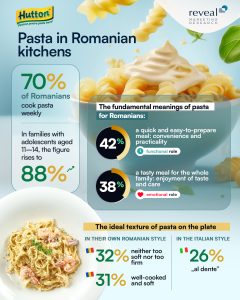
Pasta has managed to occupy a special place on the menu of Romanians: 7 out of 10 put it on the table weekly
Pasta is a frequently bought product: almost 8 out of 10 Romanians (78%) have bought pasta in the last month. In the kitchen, 45% of Romanians cook pasta about once a week, and 25% several times a week.
The frequency of consumption increases with the number of family members. For example, in households with four people, the incidence of weekly consumption reaches 77%, compared to 59% in the case of those who live alone. The frequency of pasta consumption is also strongly influenced by the presence of children in the household. Thus, 78% of households with minor children cook pasta at least once a week, compared to 63% of those without minor children. Looking closer, pasta most often reaches the tables of families with adolescents aged 11–14: 88% of them cook it at least once a week.
Younger generations include pasta more frequently in their diet. A third (33%) of Generation Z (14-29 years old) say they cook pasta several times a week, compared to only 10% of Baby Boomers (62–80 years old). Pasta is also more present in large urban centers (cities with more than 200,000 inhabitants), where 32% of respondents cook it several times a week.
The fundamental meaning of pasta for Romanians: combining the useful (42%) with the pleasant (38%)
When thinking about pasta, 42% of Romanians associate it primarily with a quick and easy-to-prepare meal, and 38% with a tasty meal for the whole family. The association with Italian cuisine is less strong: only 8% of Romanians mention this aspect. However, it becomes more relevant among young people aged 18–24 (19%) and households with incomes over 15,000 lei (16%).
The meaning of pasta also differs depending on the consumer’s profile. Women perceive it more frequently as a practical solution for a quick and easy-to-prepare meal (46%, compared to 37% of men), the same association being more often found among Millennials, aged 30-45 (47%).
Pasta is prepared in Romanian, according to your own taste. Only 26% boil pasta “al dente”, Italian-style
When choosing the type of pasta, a third of Romanians (33%) prefer pasta with eggs, regardless of the type of flour. In second place is pasta made from 100% durum wheat (20%), followed by whole wheat pasta (14%). For 13% of Romanians, the type of pasta does not matter, the main criterion being the price. Soft wheat pasta (8%), soft and durum wheat mixture pasta (7%) and gluten-free pasta (4%) remain niche choices. Wholemeal pasta is more popular among Millennials, aged 30-45 (18%), parents with children under 3 years old (20%) and residents of Bucharest and Ilfov (19%).
In terms of texture, 32% of Romanians choose to cook pasta “neither too soft nor too hard”, 31% prefer it well cooked and soft. Only 26% opt for the “al dente” texture, as an Italian would serve them. Well-boiled and soft pasta is preferred especially by Millennials, aged between 30-45 years old (36%), while the “al dente” texture has the most followers in Banat (33%) and in households with incomes over 15,000 lei (35%).
When the price is similar, the origin of pasta divides Romanians’ preferences: 38% choose pasta made in Romania, and 36% pasta made in Italy
When choosing between several Italian pasta brands, 56% of Romanians are looking for a brand recognized for the quality of pasta, and 17% are looking for a well-known brand. Thus, about three-quarters of Romanians (73%) take the brand into account when choosing. Another 15% buy what they find at the time, and 11% choose any brand on promotion. Brand orientation increases with income, from 68% in households with incomes below 8,000 lei to 84% in those with incomes over 15,000 lei.
“The data reveal an interesting contrast: Romanians can buy ‘Italian’, but they cook and consume ‘Romanian’. Over a third would choose, at a similar price, pasta made in Italy, and 56% would look for an Italian brand recognized for its quality. Once in the kitchen, however, pasta enters the Romanian cooking ritual: only a quarter of Romanians (26%) prepare it ‘al dente’, the texture traditionally associated with the Italian style,” said Marius Luican, General Manager of Reveal Marketing Research.
When the price is similar, Romanians’ preferences are almost equally divided between pasta made in Romania (38%) and pasta made in Italy (36%). For 16%, the choice is determined by the type and quality of pasta, and for 10%, by the brand.
The differences are clearer between generations. Generation Z (14-29 years old) leans towards pasta made in Italy (49%), compared to 29% for pasta made in Romania. On the other hand, Romanians aged 45-54, representatives of Generation X, prefer pasta made in Romania more frequently (46%), compared to those in Italy (32%).
“35 years after its establishment, Hutton continues to offer products adapted to the taste and preferences of Romanian consumers. At the confluence of Transylvanian culinary traditions, Hutton produces pasta in a wide variety of shapes and compositions. We use a mixture of carefully selected special semolina flours for pasta – from common wheat, durum wheat and corn – to which we add fresh eggs in a generous percentage, up to 40%. Thus, we obtain tasty pasta, which requires a short boiling time and retains its texture and pleasant appearance, with a medium consistency (neither too soft nor too hard), the texture preferred by most Romanians. Our mission is to bring together the Transylvanian tradition, cutting-edge Italian technology and the best ingredients, to exceed the expectations of our consumers.”, said Hutton Richard, Administrator of Hutton SRL.
***
About Hutton
Hutton is the largest producer of pasta with wholly Romanian capital in Transylvania and one of the leaders of the Romanian market.
A family business in the north-west of the country, Hutton produces pasta in its factory in Satu Mare according to its own recipe, kept for three generations. The portfolio includes over 90 varieties, from classic pasta, such as feathers, snails, spirals and spaghetti, to Transylvanian specialties such as rhombuses, leaves, snails, gârtene /csiga and răzălăi (from semi-hard, grated dough) – ranges structured precisely according to the number of fresh eggs used per kilo of flour: 2, 4, 6 or 8 (pieces).
Hutton is especially known for its fine homemade noodles and pasta for soups and soups. Among its products are the Wedding® Noodles, prepared with 8 eggs, which retain the rich taste and color specific to traditional Transylvanian noodles.
Hutton products are available in most counties of the country, both in traditional trade and in local, regional and national retail networks. The manufacturing process is carried out within a quality and food safety management system certified according to ISO 9001, FSSC 22000, ISO 22000 standards.
About Reveal Marketing Research
Reveal Marketing Research is a full-service market research company, specialized in marketing research, sociological studies, customer insight, business strategy, market development. With expertise in over 20 industries, Reveal Marketing Research believes that market research is the basis for the right decisions and brand positioning. Qualitative and quantitative solutions have been helping companies in Romania and other European countries for 17 years.
Methodology: The Reveal Marketing Research study was conducted online in September 2026 on a representative sample for the universe of people aged 18+, internet users, in urban areas. The sample size was 1007 respondents, and the maximum sampling error is +/-3.1% at a confidence level of 95%.