
“Better safe than sorry”: 9 out of 10 Romanians believe that children’s access to social networks should be regulated by law
Reveal Market Resources, study no. 209
The latest study conducted by Reveal Marketing Research analyzes Romanians’ perceptions regarding the restriction of access to minors under 16 years of age on social networks. In parallel, the study explores the reality of the new generation of students, in which the use of artificial intelligence for school tasks has become an extensive practice, assessing parents’ perspectives.
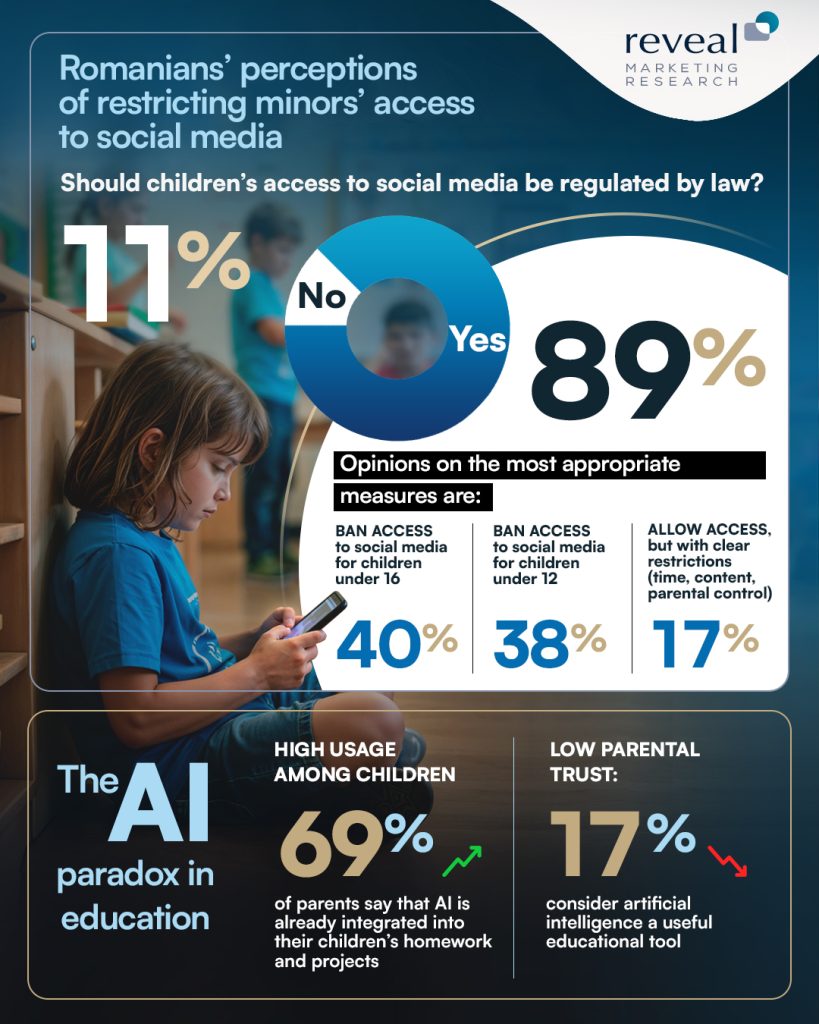
- 89% of Romanians believe that children’s access to social networks should be regulated by law.
- The main reasons behind the restriction are fear of exposure to age-inappropriate content (81%), concern for mental health (80%) and the risk of screen addiction (72%).
- In the case of the 11% who would not support such a regulation, the main solution is not the “closed door” by the state, but the guidance of the parent (62%).
- The AI paradox in education: 69% of students use artificial intelligence for homework and projects, but only 17% of parents consider it a useful educational tool.
9 out of 10 Romanians believe that children’s access to social networks should be regulated by law
The data from the study conducted by Reveal Marketing Research outline a climate of opinion clearly oriented towards protecting children in relation to social networks: 70% of Romanians believe that they have a rather negative impact, and 89% believe that children’s access to social networks should be regulated by law.
The subject of banning access to social networks for children under 16 is known by 90% of Romanians, which indicates high visibility. At the same time, 67% say that they consider themselves to be largely and very much informed about this topic, the percentage being significantly higher among those who have children (70% compared to 63% in the case of those without children).
Support for restrictive measures is mainly fueled by fear of exposure to age-inappropriate content (81%), concern for mental health (80%) and the risk of screen addiction (72%), while risks of cyberbullying (56%) or social pressure (42%) are mentioned less frequently. The emphasis is therefore on preventing the effects perceived as direct and immediate on the child, rather than those related to his interactions with others.
As for the potential regulations of such a law, opinions are divided between firm bans and differentiated limitations: 40% would support banning access to social networks under 16 years of age, and 38% under 12 years of age, while only 17% would prefer allowed access with clear restrictions on time, content and parental controls.
“Romanians are in a stage of defensive reaction. There is a broad consensus that the digital environment is dangerous for children, from social media to artificial intelligence, and the current context is perceived as risky. As a result, one of the preferred solutions remains state-imposed restriction rather than critical education. Our society emphasizes protection, but it still does not master the nuances of emotional health in the age of algorithms,” said Marius Luican, General Manager of Reveal Marketing Research.
Only 11% of Romanians would not support a legal regulation, to a significantly greater extent young people between 18-24 years old (25%), men (15% compared to 8% in the case of women) and those without children (18% compared to 8% in the case of those with children).
For them, the solution is not the “closed door” by the state, but the guidance of the parent (62%). Other arguments such as the difficulty of applying the bans (40%), the need for access to information (37%) or the need for online socialization of children (24%) were mentioned to a lesser extent.
There is a clear difference between what Romanians think they “should” happen and what they would actually “do” as parents. Although 67% consider the 16-year threshold to be acceptable for a child to have an account on social networks, this principle falters when they think about imposing it on their own child, the percentage dropping to 59%. The data suggest an adjustment of principles according to social reality and the pressure of integration into the peer group.
In the context of alternatives to a total ban on social networks, women are more supportive of control and limitation measures, such as limiting screen time (72% vs. 60% among men), age verification (65% vs. 57% for men) and stricter rules for platforms (60% vs. 51% for men), while men attach more importance to digital education in schools (59% vs. 48% for women).
At the public policy level, 52% of Romanians would prefer alignment with European legislation, and 39% an approach adapted to the national context, which indicates a balanced expectation between external standards and local specificity.
The AI paradox in education: 69% of students use artificial intelligence, but only 17% of parents consider it a useful educational tool
Although 69% of parents confirm that AI is already integrated into their children’s homework and projects, the high level of use does not equate to parents’ trust in this tool: only 17% consider AI a useful educational tool, while the rest see it as a modern form of copying (27%) or as a tool whose value depends strictly on how to use it (48%). This gap between use and parents’ perceptions is fueled by the fear of addiction, a risk perceived by 38% of them, in contrast to only 25% who are convinced that AI helps children understand the subject better.
Faced with this reality, parents adopt A vigilant pragmatism, only 19% opting for total ban on the use of, while the majority prefer Limiting the use to theoretical explanations (39%) or controlled use, with limitations (29%). The analysis also reveals a gender difference in approach: while fathers are more optimistic and inclined towards controlled use (37% vs. 23% for women), mothers are more skeptical, being more likely to completely ban children’s access to AI for educational purposes (23% vs. 13% for men).
***
About Reveal Marketing Research
Reveal Marketing Research is a full-service market research company, specialized in marketing research, sociological studies, customer insight, business strategy, market development. With expertise in more than 20 industries, Reveal Marketing Research believes that market research is the basis for the right decisions and brand positioning. Qualitative and quantitative solutions have been helping companies in Romania and other European countries for 17 years.
Reveal Market Resources, study no. 209: Reveal Market Resources is a data hub that includes free studies given to publicity, with the aim of supporting the marketing and communication market in Romania.
Methodology: The Reveal Marketing Research study was conducted online between 17-22.02.2026 on a nationally representative sample for the universe of people aged 18+, internet users, from urban and rural areas. The sample size was 1008 respondents, and the maximum sampling error is +/-3.1% at a 95% confidence level.